Smart building managers and HOA boards are at a turning point.
The challenge is no longer just managing vendor contracts or basic property upkeep. It’s unmonitored water leaks. It’s failing HVAC chillers in the middle of summer. It’s vulnerable access gates. And most importantly, it’s what happens to your facility data when the internet goes down.
In a recent conversation at the Truway office, we broke down what I believe is one of the most important shifts underway in property management: the move from fragmented, cloud-dependent gadgets to a fully connected, resilient hybrid edge-cloud IoT ecosystem.
Here are the key takeaways.
1. Real-time visibility is no longer optional.
Modern residents and tenants expect seamless, proactive management. Generic scheduled maintenance and manual daily walkthroughs of the property alone won’t prevent a catastrophic pipe burst or an unnoticed equipment failure. Property owners expect precise facility telemetry, delivered in real time.
If smart buildings and residential communities want to protect property values and reduce insurance premiums, they must move toward automated IoT environmental sensors and data-driven alerting.
2. Local survivability drives true resilience.
Operational continuity isn’t just a “nice to have” , it’s a critical requirement for facility safety.
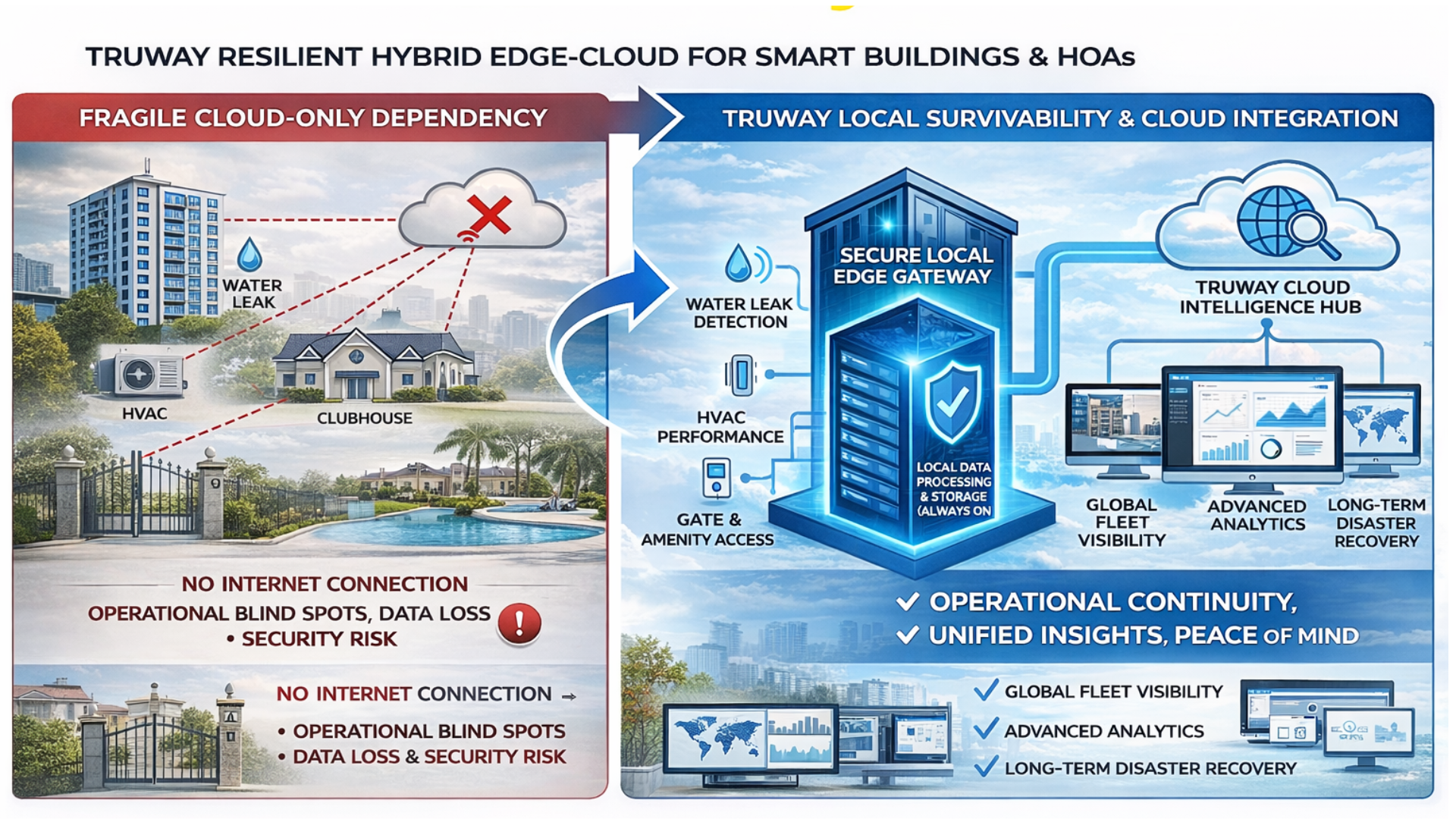
A key strategic focus for any modern property is local survivability. If a storm hits or an ISP outage occurs, your building shouldn’t go dark. A resilient Truway hybrid edge cloud architecture ensures that environmental data is processed and stored on-site even during complete internet outages. Local edge gateways continue to process data, trigger critical local alarms for property managers, and keep systems running autonomously when you need them most. That’s not theory. That’s execution.
Learn about Truway Professional IoT Solutions.
3. Data unification is the real advantage.
Many HOAs and building managers collect data in pieces, pool temperature logs here, fitness center humidity there, pump room vibrations somewhere else.
But when you unify these environmental sensors and equipment health metrics into one Truway intelligence layer, something powerful happens:
- You can monitor diverse community assets centrally.
- You can automate preventative maintenance for expensive shared infrastructure.
- You can forecast utility costs accurately.
- You can achieve regulatory compliance with auditable proof.
This is where property management begins to operate at a much higher level.
See how Truway Delivers Operational Intelligence.
4. Monitoring must happen everywhere.
Today’s winning properties monitor assets comprehensively:
- In the pump rooms: Water leak detection and pressure monitoring.
- At the amenities: Pool health, clubhouse climate control, and gym air quality.
- On the rooftops: HVAC efficiency and preventative maintenance alerts.
- At the edge: Local data processing and immediate, latency-free alerting that survives internet drops.
This isn’t about adding smart gadgets to a building. It’s about building a connected Truway ecosystem that keeps your community optimized, comfortable, and secure 24/7.
See the Truway IoT Ecosystem and how it can work for your property.
5. Cloud integration provides the ultimate safety net.
While the edge handles immediate, local threats, the cloud is where your long-term strategy lives.
The Truway system seamlessly integrates your locally surviving edge networks with the cloud to provide global visibility, advanced analytics, and long-term disaster recovery. Property management groups overseeing multiple HOAs or building portfolios can view fleet-wide analytics, compare year-over-year asset performance, and securely back up historical data for insurance and compliance purposes.
This is how property managers move from reactive to strategic.
The most important message?
The cost of an operational blind spot like an undetected weekend water leak is far greater than the cost of investing in a resilient IoT ecosystem.
If you’re managing smart buildings or residential communities, waiting is not a strategy. The properties that act now — who implement hybrid edge-cloud networks, ensure local survivability, and unify their sensor data will be the ones attracting top tenants and operating safely, while others struggle to maintain basic margins.
The future of property management isn’t bigger.
It’s smarter.